Chitwan National Park
Chitwan National Park
Chitwan National Park protects a stretch of Nepal's lowland Terai, where grassland, sal forest, and river channels support one of the strongest greater one-horned rhino populations in the world alongside tigers, gharial, and outstanding birdlife. It is strongest for travelers who want accessible South Asian wildlife on a Himalaya trip.
Where to find the wildlife
Chitwan is a mosaic of tall elephant grass, riverine forest and open river, and each habitat holds different animals. The grassland is where rhinos are, the rivers hold gharial and dolphins, and the sal forest is where you look for the things that are harder to see. Moving between them across a couple of days is how the park is best used.
The riverine grassland and floodplain along the Rapti and Narayani rivers are rhino country. Greater one-horned rhino graze in the open here at dawn and dusk and are seen on the majority of visits — often at close range from a jeep or on foot with a guide.
The rivers themselves are best worked by dugout canoe in the early morning, drifting past mugger crocodiles on the banks and gharial — the narrow-snouted fish-eating crocodilian that is one of the park's conservation successes — with kingfishers and storks along the margins. The gharial breeding centre near Kasara explains what you are looking at.
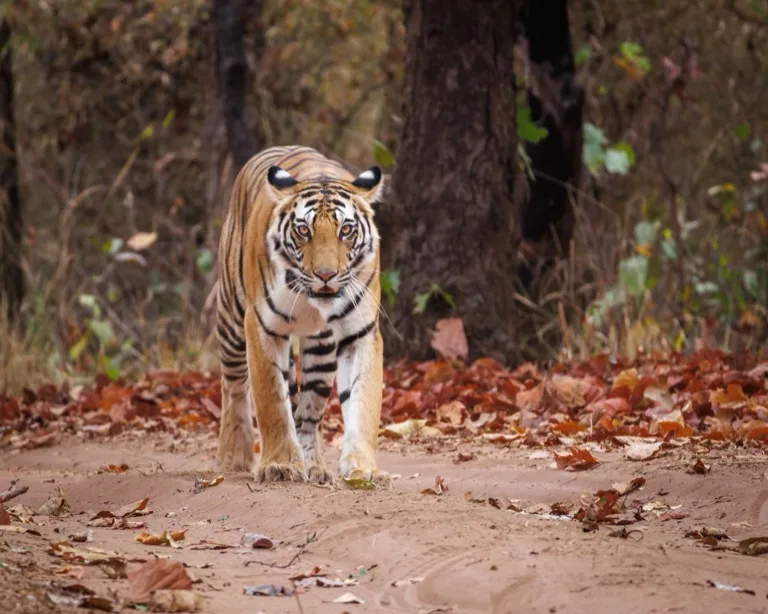
The sal forest is where sloth bear, leopard and the park's tigers live. Tigers are present in good numbers but genuinely difficult in this thick habitat: treat a sighting as a bonus, not the plan.
The community forests and buffer zone around Sauraha are surprisingly productive at first light for birds and often for rhino that have wandered out of the park overnight.
October to March is the reliable season, with clear post-monsoon air and comfortable temperatures. Late January and February bring the annual grass cutting, which briefly opens up sightlines and makes for exceptional viewing.
Practicalities
Sauraha is the main gateway and holds most of the budget and mid-range lodges; the quieter western sector is reached from Meghauli. Chitwan is a five- to six-hour drive from Kathmandu or a short flight to Bharatpur.
Entry permits, jeep safaris, canoe trips and guided walks are all arranged through park-authorised operators, and walking in the core area is only permitted with licensed guides — sensible in a park where rhino, sloth bear and elephant are all capable of charging.
Gallery
Wildlife Species
Greater One-horned Rhinoceros
UncommonMammal · Best time: Morning and Late Afternoon
Bengal Tiger
RareMammal · Best time: With luck on longer jeep safaris
Gharial
UncommonReptile · Best time: Sunny riverbank periods
Lesser Adjutant
UncommonBird · Best time: Morning in wetland and grassland sectors
Geography
- Terrain
- Riverine forest, tall grassland, wetlands, oxbow lakes, Siwalik foothills
- Elevation
- About 100-815m
- Climate
- Humid subtropical lowland
- Area
- About 932 km2
Weather
- Best Months
- NovemberDecemberJanuaryFebruaryMarchApril
- Avg. Temperature
- 7-35°C
- Rainfall
- High in the monsoon, with the cooler dry season best for visibility, road conditions, and wildlife watching
- Humidity
- 40-95%
Getting There
Bharatpur Airport or Kathmandu with onward road transfer to Sauraha and other gateways
One of the easiest major wildlife destinations in mainland South Asia to reach and use
- Jeep safaris and river-edge wildlife drives
- Canoe trips and birding walks
- Stay in Sauraha or quieter buffer-zone lodges
(Affiliate link — we may earn a commission.)
Tours & Experiences
Local guides substantially improve Greater One-horned Rhinoceros sighting odds — compare independent operators and dates for Chitwan National Park below.
(Affiliate links — we may earn a commission.)
Where to Stay
Safari lodges in Sauraha and nearby buffer zones
Budget to PremiumLodge · Main practical base for the park
Check availability on Booking.com →Riverside resorts and naturalist-focused stays
Mid-range to PremiumResort · Short transfer to safari entrances
Check availability on Booking.com →(Affiliate links — we may earn a commission.)