Phobjikha Valley
Phobjikha Valley
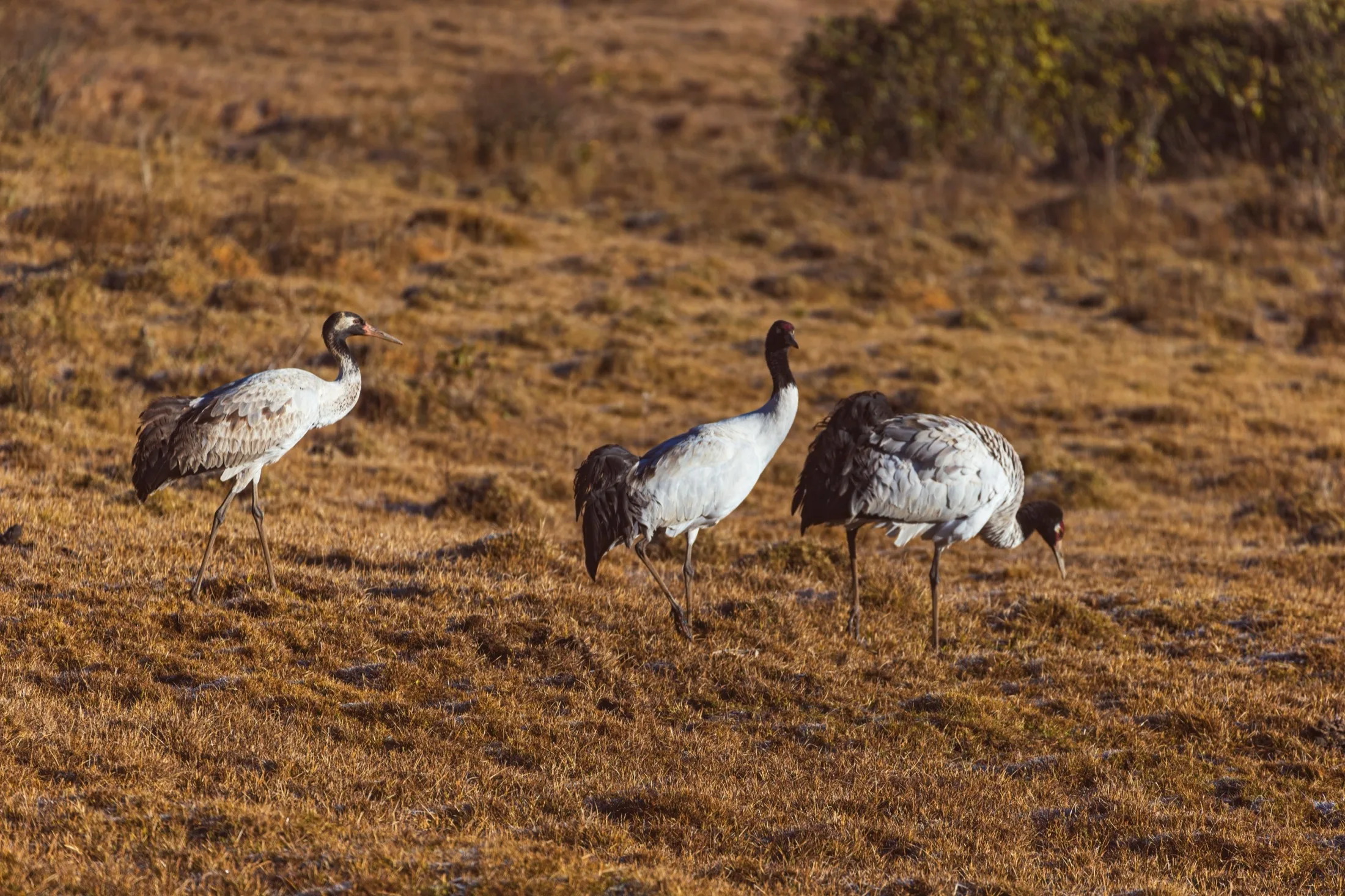
The Phobjikha valley is Bhutan's most important wintering ground for black-necked cranes, a broad glacial bowl beneath the Gangtey monastery where several hundred cranes arrive each autumn from Tibet. It is strongest for travelers who want a defined wildlife event within a Bhutan itinerary.
Where to find the wildlife
The valley is a wide, treeless marsh surrounded by forested slopes, and the cranes feed out on the open wetland where they are visible from the valley edges. This is watching from a distance rather than a close encounter — the whole valley is managed to keep it that way.
The Crane Information Centre at the valley's edge is the obvious first stop, with telescopes trained on the feeding grounds, a hide, and daily counts through the season. Staff know where the birds are that morning.
The Gangtey Nature Trail, an easy walk down from the monastery through pine forest and out along the valley edge, gives the best overall views and passes the traditional farmhouses that make the landscape what it is.
The marsh itself is protected and access is restricted — deliberately, since disturbance is what drove cranes from other valleys. Watch from the paths and the centre rather than walking out onto the wetland.
The surrounding forest holds muntjac, wild boar, Himalayan black bear in season, and a good bird list including satyr tragopan and Himalayan monal on the higher slopes.
The cranes arrive from late October and stay until around February, circling the monastery on arrival and departure in a ritual the valley's people watch for. The Black-necked Crane Festival is held at the monastery in November each year, combining masked dance with crane conservation.
Practicalities
Phobjikha is around four to five hours' drive from Thimphu over a high pass. All foreign visitors to Bhutan travel on an approved itinerary and pay a Sustainable Development Fee, currently 100 US dollars per person per night for most nationalities, with reduced rates for Indian nationals and for children — confirm the current figure when booking, as it has changed more than once.
The valley sits at around 3,000 metres and is genuinely cold in winter, with limited heating in the traditional guesthouses. Electricity was deliberately laid underground here to keep power lines out of the cranes' flight paths — a small detail that says a lot about the place.
Gallery
Wildlife Species
Black-necked crane
UncommonBird · Best time: Winter valley visits
Himalayan monal, pheasants, and forest birds nearby
UncommonBird · Best time: Morning forest edges
Red fox and Himalayan valley mammals
UncommonMammal · Best time: Dawn and dusk
Raptors and high-valley birds
CommonBird · Best time: Daytime
Geography
- Terrain
- High glacial valley, wetlands, pasture, pine forest, village landscapes
- Elevation
- High Himalayan valley
- Climate
- Cool temperate to cold mountain
- Area
- Valley and conservation landscape in central Bhutan
Weather
- Best Months
- NovemberDecemberJanuaryFebruary
- Avg. Temperature
- -8-18°C
- Rainfall
- Winter crane season is the main timing; nights are cold and roads can be slow
- Humidity
- 35-80%
Getting There
Paro with long road journey through Bhutan
Accessible within Bhutan itineraries but still a long mountain-road transfer
- Black-necked crane wintering trip
- Bhutan birding circuit
- Himalayan cultural and wildlife route
(Affiliate link — we may earn a commission.)
Tours & Experiences
Local guides substantially improve Black-necked crane sighting odds — compare independent operators and dates for Phobjikha Valley below.
(Affiliate links — we may earn a commission.)
Where to Stay
Phobjikha valley lodges and farm stays
Mid-range to PremiumLodge or Farm Stay · Best local bases
Check availability on Booking.com →Wangdue and Punakha hotels
Mid-range to PremiumHotel · Regional itinerary bases
Check availability on Booking.com →(Affiliate links — we may earn a commission.)